Tuesday, 11 June 2019

Ahoy there!

With the the 75th Anniversary of D-Day safely negotiated and James' triumph of a lecture to the school done, I have time to reflect on a couple of other pieces that went into making the project such a success.  During his research, James kept coming across reference to at least two German gunboats that were involved in the action around Pegasus Bridge.  If you look into this, and trust me we did, there are conflicting accounts as to what they might actually have been.  A common thought was that they were civilian trawlers requisitioned by the Kriegsmarine and fitted out as Flakships.  The Vorpostenboote, as they were known, were a common sight around coastal areas and so we thought it highly possible that these might have been the boats referred to in the eyewitness accounts.
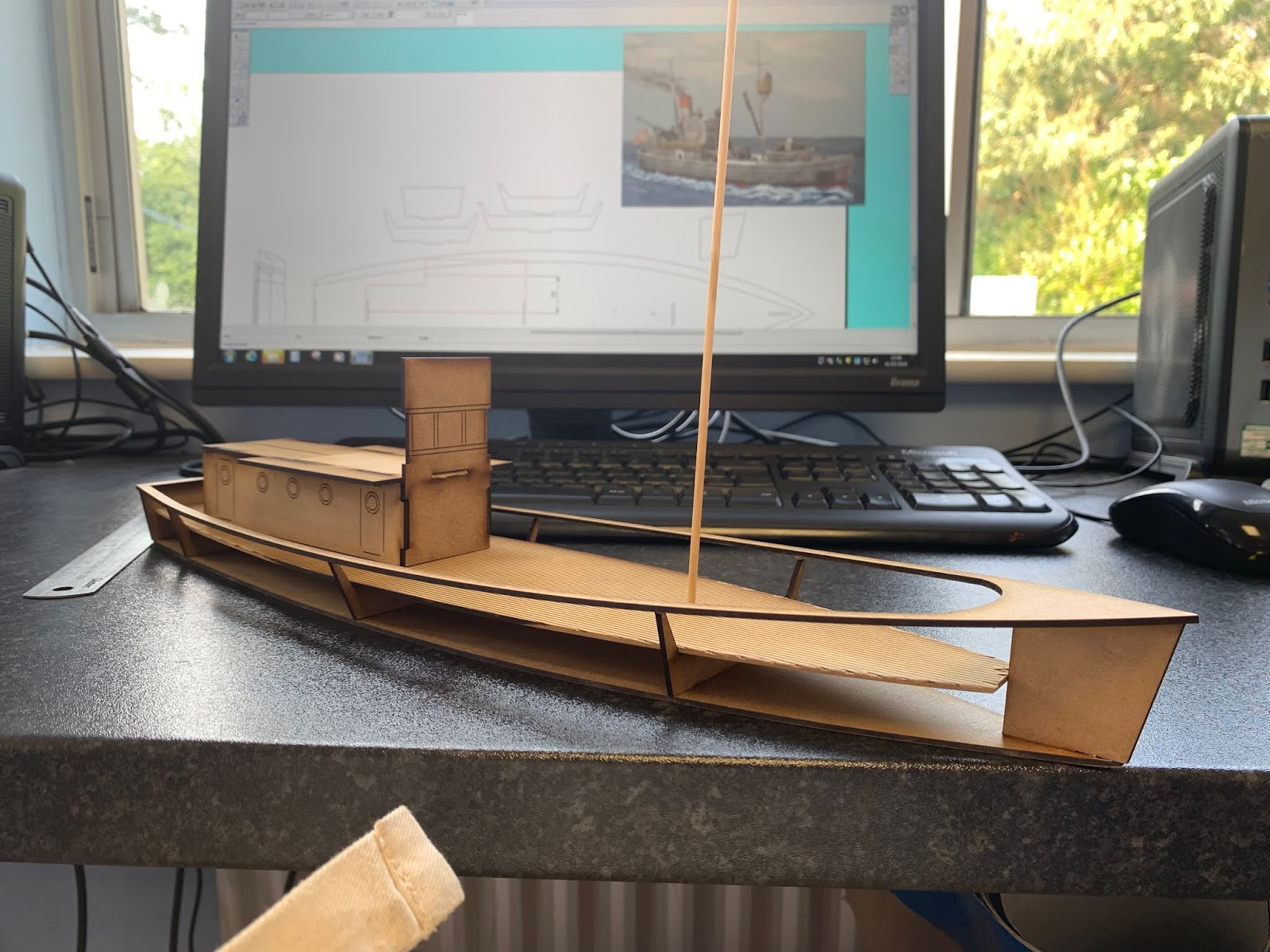
"We could build some", said James.  This was becoming an all too familiar cry at this stage and I have learnt that the best thing to do in these situations is to buckle up and enjoy the ride!  We didn't have an awful lot of reference material to work with, a few grainy photographs care of the info web, was seemingly as much as we could hope for.  By chance, James stumbled across a picture of a 20mm scaled armed German Trawler available from 'Grubby Tanks' and now with a pre-conceived idea of what he was aiming for, off he went!

Within hours the prototype was produced and it was already apparent to me that this was going to be a bit of a showstopper.  James was really enjoying the design process, but also the idea of minimalising waste, designing his drawing to fit on to one sheet of 2mm MDF.
James very kindly put the basic carcass together for me, cut himself a second boat, and so it was that we parted for the Easter holidays.  With the boat safely docked on the painting table, I was suddenly faced with all manner of decisions to finish off the project.  There was so much delicious detail to work with when it came to painting, but I still had a couple of things to fix first.   
The forward gun platform required the addition of some cocktail sticks and these were also employed for the bridge's hand rail, with the addition of some plastic strip.  The plastic wasn't an ideal fix, but at this stage I was considering adding flak barriers made from Milliput so wasn't unduly worried.  

I fashioned a hold hatch out of mount board, which was also used for the hull.  Whilst I had the Milliput out, I considered the idea of adding some rope fenders.  These were to be attached using the wire hoods found on Prosecco corks, but just couldn't get the right shape and so resorted to wooden beads instead.  I salvaged some resin chandlery from the bits box along with some oil drums.  A pole for the ensign was fixed and with the addition of some armaments from the very reasonably priced 'Anyscale Models', the basic construction was complete.

It was at this point that we had to return to school and compare homework, so to speak.  James had fashioned a funnel from some copper pipe, heating a ball bearing to force into one end to create a beautifully fluted look.  He had very kindly done one for me and I managed to persuade him to cut some additional pieces for the handrail following my abortive Milliput episode.  We also discussed the gun emplacements and deciding that I was going to use my boat for all manner of pulp adventures, quite fancied the ability to swap out the pieces as required.  In no time at all James had cut discs capable of holding magnets to facilitate this very idea. 
With some final flourishes, including a ship's whistle and a liberal smattering of rivets, the build was complete and the boat was given its final base coat.
I stared to carefully pick out the various details in colour and was thrilled with the progress, but something didn't feel quite right.  It wasn't until the night before we had arranged to photograph the entire model that I realised what it was that was troubling me - the boat was too clean!  Weathering is always a concern, when does it become too much?  Still resolved to give it a go, I started working in around the areas I thought would be caught first.  
 So with the boat completed the crew, from 'Artizan Designs', were able to step aboard and my Vorpostenboot set sail for Pegasus Bridge.
This was such a joy to work on and once again, I can't thank James enough for his generosity.  I am thoroughly looking forward to seeing how this marvellous model will be put to use in the future.


Thursday, 6 June 2019

Operation Deadstick

Today, the 6th June 2019, marks the 75th anniversary of the D-Day landings, the largest seaborne invasion in history.   The landings heralded the start of the liberation of Europe that would ultimately bring about the end of World War II.  My friend and colleague, James wanted to commemorate the event with a presentation to pupils, parents and staff; his presentation focusing on one crucially important operation, codenamed ‘Deadstick’, its role in the wider operation and what lessons can be learnt from such endeavours.
  
Operation ‘Deadstick’ was conceived to capture and hold the bridges over the River Orne and the Caen Canal, securing the flank of those troops that would land on ‘Sword’ beach by preventing the German Army from sending reinforcements to the landing grounds.  It proved to be an overwhelming success, due mainly to meticulous preparation, the bravery of those involved and a fair amount of good luck.

In preparing for the talk, James stumbled upon the idea of actually building the bridge to illustrate his presentation.  Using his incredible engineering skills, James designed and built a replica of what is now referred to as Pegasus Bridge, working only from original photographs and drawings.  As is often the case, the project suffered from a dose of ‘Mission Creep’ that subsequently saw the inclusion of the gliders’ landing area, the Café Gondrée and even an armoured trawler or two!  Such was James’ enthusiasm for the project that I could not help but contribute where I was able.  The whole process has been an absolute joy and a privilege to work on, thank you James!
We decided to photograph the model in low light, which allowed the blast markers to work their magic; they really could not have been more effective. In the above photographs the only post production has been the occasional removal of an annoying chair leg or camera tripod, a testimony to the quality and creativity of James’ work. The project became all consuming and included the base, which can be broken down into three parts and is supported by a purpose built steel frame. James kept a photographic record of the process and has published this on YouTube, please go and have a look to get a greater understanding as to the enormity of the project, the link is below.  What started out as an idea tossed around the classroom has blossomed into a truly magnificent project that, at its heart, is designed to educate and keep alive the memory of those that were willing to sacrifice everything for the freedom of others.  

"We will remember them."

Please visit James' behind the scenes look at


Tuesday, 4 June 2019

Opposition & Blast Markers!

So as mentioned in the previous post, 'Preparations', I have ingratiated myself into someone else's project to commemorate the seventy fifth anniversary of 'Operation Deadstick', the action that saw the bridges in and around Bénouville to be taken and held ahead of the D-Day landings.  Such was the level of enthusiasm for the project that it was hard not to be swept away with it all.  James’ bridge continued to grow with ever increasing levels of complexity as he started to work out how the cantilever would have worked or even how best to represent the ornamental railing that ran alongside the footbridge. 
Having already assembled and painted some Paratroopers to represent the Oxfordshire and Buckinghamshire Light Infantry, the first troops on the bridge at Bénouville, my thoughts turned to the defenders.  Now at this point all aficionados and military historians should look away.  As we only wanted to illustrate the action to accompany the twenty miniature lecture, admittedly ten minutes longer than it took to take the bridge, I was happy to play fast and loose with historical accuracy and so went in search of miniatures that could represent the hard pressed troops that were completely taken by surprise that fateful evening.  As it happens 'Wargames Foundry' produce a wonderful set of dour German sentries and because time was of the essence, I selected the ones in greatcoats for ease of painting.*  With a suitably harassed officer, found on the 'Artizan Designs' site, along with some French civilians, but more of them another day, the small garrison was complete.
*Although I did fiddle around with some waterslide transfers for the helmets!
The problem with a project like this is knowing when to stop.  James was creating something rather special here, but I was conscious that I was muscling in on someone else’s baby and made my worries known.  In a spirit of generosity, that is the mark of the man, James simply told me to ‘interfere’ as much as I wanted to and so I felt the urge to continue adding where I could.  This saw all manner of little paint jobs undertaken, from the troops mentioned to painting up the staff car from ‘Anyscale Models’
James and I had discussed the action with Sgt. Thornton and the still hotly debated armoured vehicle that erupted into flame and a spectacular firework display of ordnance having received a direct hit with the PIAT.  Several options were explored, but at this stage I was channelling a quite unhealthy ‘Allo! ‘Allo! vibe and so plumped for the 'Warlord Games' German Sd.Kfz.222, which is now known around the studios as ‘Gruber’s Little Tank’.  
We talked about the near fatal first encounter with the British troops and the café owner, Georges Gondrée.  How his bedroom was raked with bullets when he appeared at the window to see what all the commotion was about, what a change to the story that would have made if one of the rounds found its mark.  Still we loved the idea of a photograph taken through the window, looking down on to the bridge and so the back to the café was deliberately left unglued so it could be removed and I set about wallpapering the walls!  Additions to the room, included some furniture from ‘Charlie Foxtrot  Models’ and it was on their website where, I also spied some rather splendid sentry boxes, which added a little colour to the proceedings.
In fact on many of bits and pieces were found as the bits box was liberated including signposts, telegraph poles and a nifty little rowing boat.  
Finally then, I need to make special mention of the blast markers.  I had seen these on Dave Docherty’s 'One Man and his Brushes' site.  His tutorial was so clear that I felt inspired to put some together.  We could not have been happier with the results and as you will see in the next post they worked so well ann helped to bring the piece to life.  I shall refrain from repeating the tutorial, but the link to the post in question is here.  Incidentally, you should also take a moment to marvel at the game Dave and his friends have just put on – wow!

Sunday, 2 June 2019

Preparations

Regular visitors to '28mm Victorian Warfare' will be only too aware of my crippling inability to focus on any given topic for a considerable period of time.  So when the opportunity to contribute, albeit in a small way, to a project that looked to commemorate the exploits of those brave souls some seventy five years ago, it was inevitable that I would want to get involved.  The project conceived by my friend and colleague James, was to deliver a lunchtime lecture to pupils, staff and parents on the action in and around Bénouville, now often referred to as the raid on Pegasus Bridge.  

The date for this lecture was to be 6th June 2019, well it seemed fitting, but a germ of an idea started to take root.  James had become interested in some of the MDF pieces that I had been putting together and started to wonder if he could build the bridge to illustrate his talk?  I was able to point him in the direction of the various companies that were producing such a model, but it is fair to say that this is a man who likes a challenge and so he set about designing and building his own.

Now from the outset, I need to share that James is an extraordinarily talented chap, he is far too modest to say so himself and will find all this excruciatingly embarrassing, but his engineering skills and his ability to create drawings in 2D Design and SolidWorks, is just mesmerising.  Within twenty four hours of leaving him with some pictures and drawings of the bridge, he had created working drawings that could be exported to the laser cutter.
I think he rather relished the challenge of the design process and as his understanding of the practical construction problems improved so did the complexity of his designs.  Having created the bridge to scale with 28mm miniatures it wasn't long before talk of having some troops to accompany it was had.  James subsequently 'won' some on eBay, but when they arrived there were not quite what he had hoped for and seeing that he was a little deflated, I quietly went off and ordered up a couple of sprues from 'Warlord Games' of their finest British Paratroopers to represent the soldiers of the Oxfordshire and Buckinghamshire Light Infantry.  When they arrived I constructed the first sprue myself, painted them and made a gift of them to James along with the other sprue.  So began my small contribution with the project.

I have to say that I rather enjoyed putting these chaps together, such is the quality of detail and variety of poses available on each sprue.  Once assembled, I decided to base them on 20mm MDF bases from the ever reliable 'Warbases'.  This was a deliberate decision as I knew James wanted to reduce this aspect as much as possible; they were there to illustrate the raid, not as wargaming pieces. 
James duly constructed his sprue, but seemed delighted with my offer to paint his up to match the original half a dozen that I had done.  I was well and truly hooked at this stage and was trying to find all manner of ways to help, well I hope I was helping?  
As the bridge started to take shape and with the troops completed we took stock of our achievements.  As a thank you for a job James had done for me* I had bought him the 'Sarissa Precision' Horsa Glider.  Such was his professional curiosity that no sooner than he had built it, James started to consider the possibilities of converting it to show the seating arrangements inside.  As it happens this has proved a step to far, but it did make it to the ever expanding model of the bridge and again, I was happy to oblige it with a simple paint job.  
*An amazing terrain piece for my Star Wars universe, but more of that another time.
 So as we near the actual anniversary, and of course the day of the lecture, I am hoping to share a series of posts that detail the work that has gone into illustrating what has to be considered one of the most daring and successful actions of the Second World War.
Related Posts Plugin for WordPress, Blogger...